

If the eyes are the window to the soul, the face is the frame. As humans, we search for cues in the face of who we are talking to. Important questions like, “How do you feel? Are you listening to me? Do you want to hear more?” are answered nonverbally by reading facial cues.
It is documented by scientists, psychologists and neuroscientists that facial expressions are the best measures of emotional states in terms of reliability. Humans rely on reading the face to determine how to proceed with an interaction.
But what if you couldn’t make any expressions? What if your face rebelled against movement of any kind and refused to react to any emotion your body, mind, and heart felt? What would you do? For 1 out of 500,000 children born worldwide, it’s a reality. It is called Moebius Syndrome.
Meet Kevin Nieves-Brailsford. He’s 14, loves Minecraft and Dr. Pepper. Pretty typical expectations for a teenager these days. One thing is just a little different. Kevin was born with Moebius Syndrome.
Moebius is a rare neurological syndrome that causes face weakness or paralysis to the facial muscles rending the patient unable to smile, frown or even control their eye movement. The ability to speak may or may not be a symptom as well. Kevin cannot speak, but that doesn’t keep him from communicating.
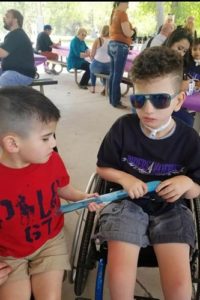
“He is a typical 14-year-old boy,” says his mom, Kacie. “He loves basketball, roller skating in his wheelchair, and goes to school.” He speaks with a Tobii Communication device. When that’s not present, he does not have a problem gesturing to what he wants or getting his point across.

“Kevin can walk with assistance and has a trach. At his age, he only has to be on a ventilator at night,” says Kacie. Even though life doesn’t sound that challenging right now, it wasn’t always like this.
For the first 14 months of his life, Kevin went undiagnosed and the family was told to expect the worst. “We didn’t get a diagnosis for Kevin for more than a year,” remembers Kacie. We were told all these horrible things: he wouldn’t live to be 6 months old; he wouldn’t live past a year; he would never live a normal life.” No diagnosis left the family adrift in dismay and confusion. Kevin was on a ventilator 24/7.
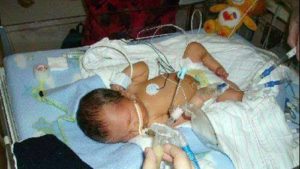
“We had no hope, no diagnosis. This is not in my personality to go along with something like that,” Kacie says. And her plans to advocate for babies and newborns only blossomed into something bigger.
When Kevin was born and in the NICU, Kacie developed a passion for nursing NICU patients. She decided to go to school because she wanted to make a difference for children and families similar to her own.
As Kevin’s story—and her own—took a parallel track, Kacie graduated from nursing school and it was her Aunt who stumbled across something on the internet—it was information and a description of Moebius Syndrome. “My aunt, who works in the forest service, found what seemed to be Kevin’s diagnosis. She sent me a link and told me to look at it.” It was indeed what Kevin had.
Kacie sent an email to an address she saw on the website. The recipient was another mom of a Moebius patient, who oddly enough, had a little boy the same age as Kevin. She confirmed that it did look like Moebius. Kacie and her family went back to the doctors which lead to a definitive diagnosis. This diagnosis opened up a new world and an incredible community to tap into.
Kacie, emboldened by an answer, knew she had work to do. It was time for her to help bring awareness to the world.
Her first step was to embrace her role as a nurse for Kevin. Although she had her sights set on working in the NICU with newborns, it just seemed fitting for her to work with Kevin as she was a certified nurse who could work with trach and vent patients. MGA was able to hire her as a caregiver.
With a diagnosis came relief, hope, and eventually, more children. When Kacie brought Kevin home from the hospital, she soon learned she was pregnant with Connor, her second child who is now 12. The family then soon started fostering a 9-year-old girl with special needs as the family’s love, compassion, and understanding grew to unknown capacity.
Kacie says that one day she knows she will work with babies in the NICU. But for now, her dedication is needed elsewhere. “Raising awareness is key for us,” she says as the family has made connections and become part of a larger community.
Kacie and her family decided to do something fun and enlisted family members for suggestions. “I have another aunt who is a big biker chick,” she says. “She told me a poker run would be a fantastic way to rally a community and raise money.”
She was right. The family has been organizing this poker run for 11 years now and every year it has grown.
The event—where bikers draw cards at various locations—then come back for a party to compare hands of cards, has now educated thousands of people about Moebius. The winning hand wins $250, however, Kacie says most people will donate that money back. “Last year we partnered with Many Faces of Mobius because we wanted to work with a nonprofit,” she says.
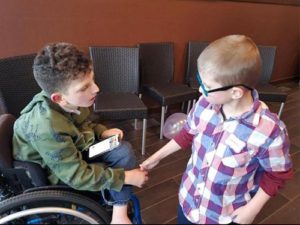
Through the poker run and other events, Kevin has met and interacted with many other children affected by Moebius. “When he was 4 years old, he first met another Moebius child,” says Kacie.
“They both just knew. He reached out to the other child – a little girl – and it was obvious they both just knew they were special.” Kacie explains that kids who have Moebius do this gesture where they put their fingers on their faces to turn up the corner of their mouths into a smile. They both did this when they met.
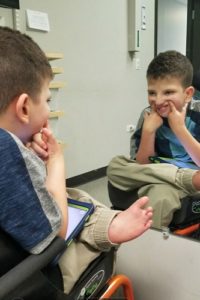
The family’s day is never typical. Kacie and her family somehow manage to balance eight therapies between two children, as well as participating in online school due to the COVID-19 pandemic.
What is the one thing that Kacie wishes people knew about Moebius? “I wish people would interact with Kevin more. He’s just a 14-year-old little boy who loves YouTube.” You connect with him on that, and you’ll definitely have a fast friend.
Are you in need of homecare services for a medically fragile child? Reach out to us. We may be able to help.
2 Comments. Leave new
Interesting article. I learned something new from this.
kickscao [url=https://www.kickscao.com/]kickscao[/url]
Well explained and easy to follow. Great job.
kickscao [url=https://www.kickscao.com/]kickscao[/url]